
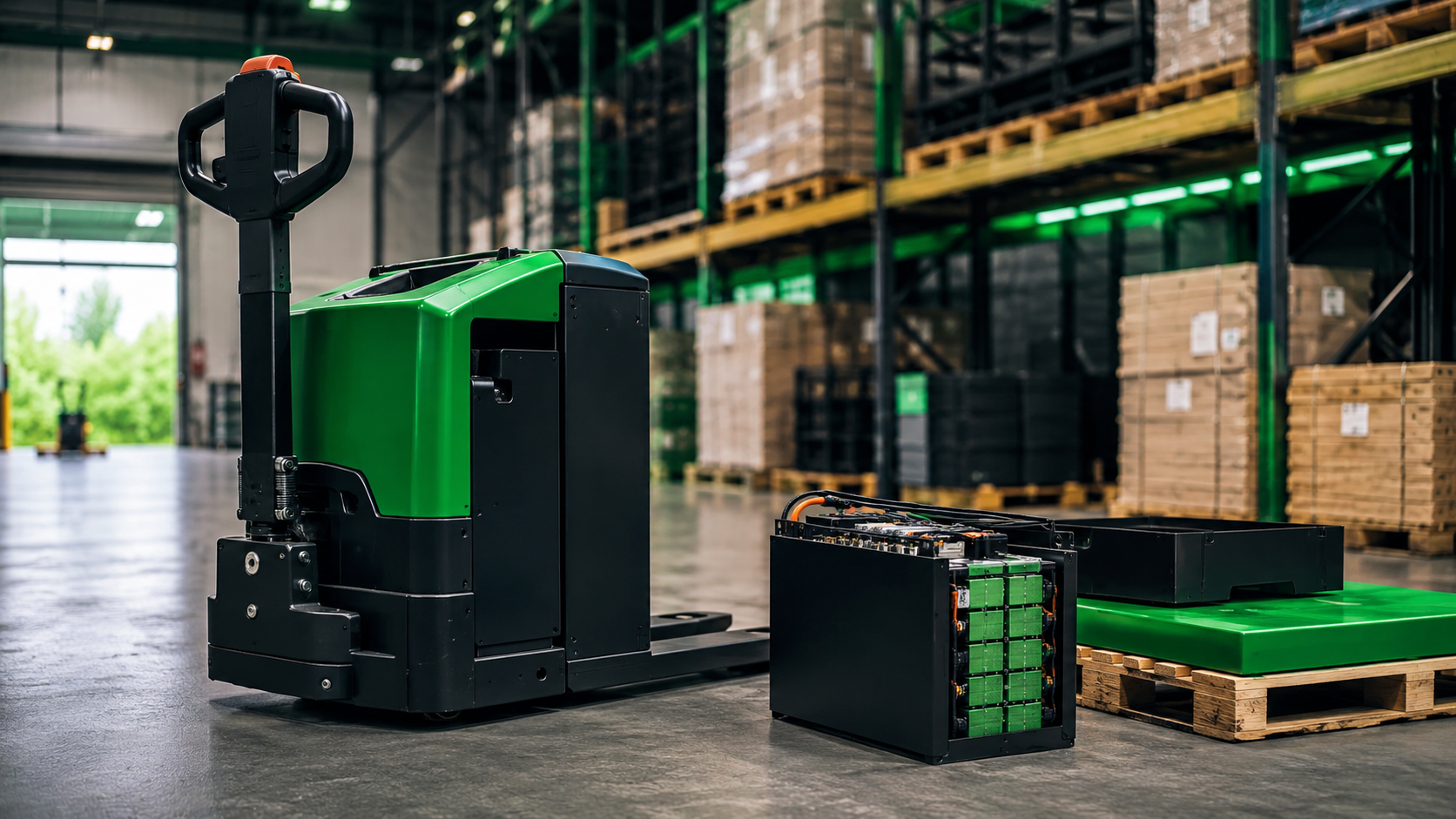
A failing pallet jack battery rarely announces itself with one dramatic event. More often, it starts quietly: shorter runtime, slower travel speed, inconsistent charging, operators switching equipment mid-shift, and supervisors hearing the same phrase over and over again: “This one is dead too.”
For busy warehouses, those small interruptions add up quickly. Walkie pallet jacks and powered pallet trucks are often used for receiving, staging, replenishment, and short-distance product movement. When they are unavailable, the operation does not stop politely. It just gets slower, messier, and more expensive.
This guide explains the most common signs that a pallet jack battery may be nearing end of life, how to separate battery problems from charger issues, and how lithium replacements can improve uptime across light material handling equipment.
Why pallet jack battery issues become uptime problems
Pallet jacks may not get the same attention as large forklifts, but they are deeply connected to daily warehouse flow. A single underperforming unit can slow down dock activity, create staging delays, and force operators to hunt for equipment with enough charge to finish the task.
That is why battery replacement should not be treated as a last-minute purchase. A weak battery affects labor planning, shift consistency, and equipment availability. When several pallet jack batteries start declining at the same time, the facility can end up with a rotating cast of half-working equipment that eats productivity one small delay at a time.
For operations managing multiple equipment types, Green Cubes’ material handling batteries solutions help connect battery selection to the broader fleet strategy, including forklifts, pallet trucks, chargers, and charging behavior.
Sign 1: runtime keeps dropping
The most obvious replacement sign is shorter runtime. A pallet jack that used to support a full shift or a predictable block of work may start needing extra charging before the same tasks are complete.
At first, this can look like operator behavior. Maybe someone forgot to plug it in. Maybe the truck was used more heavily than usual. But if the same battery repeatedly fails to complete normal work, the issue may be capacity loss.
Runtime drops are especially disruptive in peak windows. If a pallet jack dies during receiving, replenishment, or end-of-shift staging, the team has to pause, swap equipment, or move product manually. That is where battery performance turns into operational drag.
Sign 2: charging takes longer or becomes inconsistent
A weak battery can also show up as charging inconsistency. The unit may take longer to charge, appear to reach full charge but drain quickly, or fail to hold charge between shifts. This is where troubleshooting matters, because the problem may be the battery, the charger, the connector, or the charging routine.
Start by looking for patterns. If one battery performs poorly across multiple chargers, the battery may be the issue. If several batteries have problems on one charger, the charger or connection point may need attention. If operators report that charging “sometimes works,” check cable condition, connector fit, and whether the charging area is blocked or difficult to access.
Green Cubes’ motive batteries and chargers page is a useful internal resource for thinking about battery and charger planning together instead of treating them as separate purchases.
Sign 3: performance drops before the battery is empty
End-of-life battery behavior is not always about running out of charge. Sometimes the pallet jack still powers on, but it does not perform consistently. Operators may notice slower travel, weaker lifting, hesitation under load, or reduced confidence when moving heavier pallets.
This can create a productivity problem even before the truck stops completely. If operators feel like they cannot trust the equipment, they start working around it. That means switching trucks, avoiding certain tasks, or leaving the weak unit parked until someone else has to deal with it. Muy elegante el caos, pero carísimo.
A healthy battery program should support predictable performance, not just minimum functionality.
Sign 4: faults, resets, or warning indicators become common
Frequent faults or warning indicators should not be dismissed as normal aging. They are signals that the battery system, charger, or truck needs review. Continuing to operate through warnings can create larger service issues and more downtime later.
For fleets already using Green Cubes products, the Service Request page gives teams a direct path for support when a purchased battery or charger needs review. For procurement teams planning replacements, recurring fault behavior is also useful evidence that the current battery setup is no longer supporting operations.
Sign 5: physical wear around connectors or battery housing
Battery replacement decisions should include a physical inspection. Damage around connectors, cables, and the battery housing can create unreliable charging and safety concerns. Corrosion, looseness, crushed cables, or connectors that require force to seat properly are all signs that the system needs attention.
A replacement battery will not solve every issue if the charger cable, truck connector, or charging area is causing the problem. That is why the best replacement planning includes the full power path: battery, charger, connector, operator routine, and equipment use case.
When lithium replacement makes sense
Lithium replacement becomes especially attractive when battery issues are tied to uptime, maintenance, or charging limitations. Compared with traditional lead-acid routines, lithium can reduce watering and maintenance tasks, support faster charging, and make opportunity charging more practical during natural pauses in the workday.
For light equipment like pallet jacks, the uptime benefit often comes from convenience. Operators are more likely to keep equipment charged when charging is fast, simple, and located where they already pause. That reduces the cycle of “use until dead, park it somewhere, find another one.”
Green Cubes has covered the productivity benefits of lithium pallet jack batteries and the cost-benefit analysis of upgrading to lithium pallet jack batteries in more detail. Those resources are useful for teams building a replacement plan with both operations and finance involved.
Build replacement decisions around the workflow
The best pallet jack battery replacement strategy starts with how the equipment is actually used. A unit that runs short bursts in a receiving lane has different needs than one used all day across long travel paths. A single-shift facility may have different charging requirements than a multi-shift operation where equipment needs to stay available almost continuously.
Before requesting a replacement quote, document the equipment model, voltage, battery compartment, connector type, runtime expectations, and charging routine. It also helps to note where the equipment fails most often. A battery that dies during peak dock activity is a different priority than one that drains slowly while sitting unused.
Quick replacement planning checklist
Use this short list before replacing pallet jack batteries:
- Confirm pallet jack model, voltage, and battery compartment dimensions
- Review connector type and charger compatibility
- Track runtime drops and where they affect operations most
- Check whether the battery or charger is the repeat problem
- Inspect cables, connectors, and charging area conditions
- Compare lithium replacement options against downtime and maintenance costs
The goal is not just to buy a new battery. The goal is to remove the recurring failure point from the operation.
Lithium improves uptime when charging becomes easier
Replacing a failing pallet jack battery with lithium can improve uptime, but the battery is only one part of the system. Charger placement, operator habits, and charging access all determine whether the improvement sticks.
For teams already reviewing charger strategy, Green Cubes’ SAFEFlex lithium battery chargers can support a more reliable charging program for industrial battery-powered fleets. Pairing the right battery with the right charger plan helps prevent the same downtime problem from returning under a new part number.
Next step
When pallet jack battery issues become frequent, replacement should be treated as an uptime decision. Green Cubes can help review your pallet jack models, charging routine, and runtime requirements to recommend lithium replacement options that improve equipment availability and reduce avoidable workflow interruptions.
Request a quote to start matching the right lithium battery solution to your pallet jack fleet.
DISCLAIMER Please note that everything posted on this site is up to date at the time of posting. Things change and products may be discontinued at any time. Please contact us for the most up to date information.