
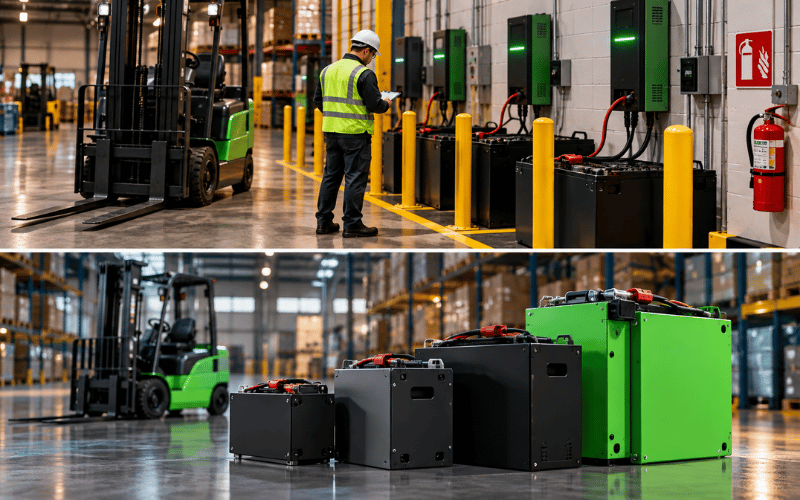
Choosing a battery for forklift equipment is not just a matter of finding something that fits in the compartment. The right battery affects runtime, charging strategy, truck performance, safety, and total cost of ownership. The wrong battery can create fault issues, short runtime, poor charging behavior, or unnecessary expense from oversizing.
For buyers comparing batteries for forklift fleets, the most important specs are voltage, capacity, physical fit, weight, charger compatibility, and application duty cycle. Each spec answers a different question. Voltage asks, “Will it work with the truck?” Capacity asks, “How long will it support the work?” Runtime asks, “Will it keep the operation moving between charging opportunities?”
This guide explains the forklift battery specs buyers should understand before requesting a quote, with examples by application and common sizing mistakes to avoid.
Start with voltage because it is not optional
Voltage is the first specification to confirm because it must match the truck’s electrical system. A forklift designed for one voltage class should not be matched casually with another. Using the wrong voltage can create performance problems, electrical faults, or compatibility issues.
Common voltage classes for material handling equipment include 24V, 36V, 48V, and 80V, depending on the truck class and application. Smaller warehouse equipment may use lower voltage systems, while heavier or higher-performance lift trucks may require higher voltage.
Before evaluating battery options, collect the truck model, manufacturer specifications, and existing battery voltage. Green Cubes’ guide on how to choose the right forklift battery is a helpful internal resource for buyers mapping voltage, fit, and operational requirements.
Capacity determines how much work the battery can support
Capacity is often where buyers focus next, but it is also where mistakes happen. A battery with more capacity can support longer operation, but bigger is not always better. Oversizing may add unnecessary cost, weight, and charging complexity. Undersizing can create mid-shift downtime and operator frustration.
The right capacity depends on the duty cycle. A forklift running light staging tasks for one shift does not need the same battery profile as a high-use truck moving heavy loads across long travel paths in a multi-shift operation.
Instead of asking only, “How many hours does the shift last?” ask, “How long does the truck need to operate between realistic charging opportunities?” That question creates a more accurate sizing target.
Runtime depends on more than amp-hours
Runtime is influenced by capacity, but it is not capacity alone. Load weight, travel distance, lift height, attachments, operator behavior, floor conditions, temperature, and charging habits all affect how long a forklift battery can support work.
A truck that drives long routes across a distribution center will use energy differently than a truck making short moves near a dock. A forklift lifting heavy loads to high rack positions will have different demand than one doing light horizontal transport. Cold storage, summer heat, ramps, and rough floors can also change real-world runtime.
That is why battery sizing should always include application details. Generic runtime claims may be useful as a starting point, but the final recommendation should be based on the way the truck is actually used.
Physical fit and weight still matter
Even when voltage and capacity look correct, the battery still has to fit the truck. Buyers should confirm compartment dimensions, cable clearance, connector location, and mounting constraints before approving a battery.
Weight is also important, especially for counterbalance forklifts where the battery contributes to the truck’s stability. A lithium battery can be engineered to meet the required weight profile, but that requirement should be confirmed early. Nobody wants to discover a fit issue after the battery shows up on the dock looking smug and expensive.
Green Cubes’ Lithium SAFEFlex PLUS batteries are designed for material handling applications where fit, weight, performance, and charging strategy all matter. For many buyers, this is where product selection becomes more specific than a simple voltage match.
Charger compatibility can make or break the program
A battery for forklift applications should never be evaluated without the charger. The charger determines how quickly the battery can recover, where charging happens, and whether the operation can support opportunity charging or multi-shift use.
If a facility upgrades batteries but leaves charging strategy untouched, it may not capture the full benefit of the investment. Charger count, charger location, electrical capacity, plug-in behavior, and operator training all affect uptime.
Green Cubes’ SAFEFlex lithium battery chargers are relevant for facilities planning a lithium battery program because they connect charger selection to industrial fleet requirements. For broader planning, the motive batteries and chargers page helps frame batteries and chargers as one system.
Avoid undersizing and oversizing
Undersizing creates obvious problems. The truck runs low before work is complete, operators search for another unit, and supervisors lose confidence in the equipment. In high-volume facilities, undersizing can create repeated downtime during the most expensive parts of the day.
Oversizing is quieter but still costly. A battery that is larger than needed may increase upfront cost without improving the operation. It may also complicate fit, weight, or charging requirements. The best battery is not the biggest one. It is the one that supports the duty cycle with the right amount of capacity, recovery time, and margin.
A practical sizing process should look at the longest operating block between charging opportunities, not just the theoretical shift length. For lithium systems, opportunity charging may allow a facility to use a battery strategy that supports continuous uptime without oversizing every truck.
Green Cubes’ opportunity charging resource explains how planned top-ups can help support uptime when paired with lithium technology and a well-designed charger layout.
Examples by forklift application
Different applications need different battery strategies. The table below shows how specs may be evaluated by common use case.
| Application | Spec priority | Battery planning note |
|---|---|---|
| Light single-shift warehouse use | Voltage match, fit, basic runtime | May not require the highest capacity if charging happens consistently after the shift. |
| Multi-shift distribution | Runtime between top-ups, charger placement, opportunity charging | Lithium may reduce downtime by supporting short charging windows during normal pauses. |
| Heavy load handling | Voltage, peak power demand, weight, thermal management | Battery sizing should account for lift height, load weight, and sustained high demand. |
| Cold storage or temperature-variable environments | Runtime margin, charging conditions, operating temperature limits | Battery and charging plans should reflect real environmental conditions, not only room-temperature assumptions. |
| High-throughput peak season operations | Uptime, charger access, fast recovery, fleet consistency | Battery specs should be matched to peak workflows, not average demand. |
What to gather before requesting a quote
A quote will be more accurate if the supplier understands the truck and the operation. Before requesting a battery recommendation, collect the truck model, voltage class, battery compartment dimensions, connector type, required weight, shift schedule, runtime expectations, charger availability, and environmental conditions.
It also helps to describe the pain point. Are batteries dying mid-shift? Are chargers creating bottlenecks? Are operators skipping charging because stations are inconvenient? Are you replacing batteries too frequently? The right solution depends on the operational problem you are trying to solve.
Specs are only useful when tied to the use case
Voltage, capacity, and runtime are not isolated numbers. They are connected to the way a forklift moves through the facility, how often it lifts, how far it travels, when it can charge, and how important uptime is to the operation.
That is why choosing a battery for forklift equipment should be treated as a fleet planning decision, not just a replacement part purchase. The strongest battery programs match truck specs, charger strategy, operator behavior, and maintenance expectations into one practical plan.
Next step
Green Cubes can help evaluate forklift battery specs by truck class, voltage, runtime requirement, charging strategy, and facility workflow. That makes it easier to avoid undersizing, oversizing, and charger compatibility issues before purchase.
Request a quote to match the right battery for forklift applications to your fleet and operating needs.
DISCLAIMER Please note that everything posted on this site is up to date at the time of posting. Things change and products may be discontinued at any time. Please contact us for the most up to date information.