Read an article from Supply Chain 247 on the benefits of lithium-ion batteries to a lift truck fleet operation
Blog
Power: How Lithium-ion Battery Technology Accelerates Industrial Electrification
Read an article from Power on how lithium-ion battery technology accelerates industrial electrification.
Ramp Equipment News: Li-Ion Tech for GSE
Our Director of Marketing, Robin Sarah Schneider, and our Business Development Director for GSE, Jerry Crump, offered their thoughts on the #lithiumionbatteries market for #gse equipment in the August/September issue of Ramp Equipment News magazine.
Airside International: Green Cubes Technology: safe and reliable Li-ion solutions
Our Director of Business Development for GSE, Jerry Crump, was interviewed for an article in the Autumn issue of Airside International on lithium-ion battery technology innovations for ground support equipment. The article starts on page 25.
Disaster Recovery Journal: Why Does My Battery Fail When I Need It Most?
Our Marketing Engineer JD DiGiacomandrea contributed an article to Disaster Recovery Journal Magazine on why batteries for critical applications can sometimes fail when they’re needed most.
Mobile Europe: Why Lithium is Taking Over Stationary Energy Storage
Our Marketing Engineer JD DiGiacomandrea contributed an article to Mobile Europe Magazine on why lithium is taking over stationary energy storage.
AviationPros Podcast: Ground Support Worldwide Podcast
Our Director of Marketing Robin Schneider joined Ground Support Worldwide editor Josh Smith to discuss Lithium-ion battery technology and its use in ground support equipment.
Airports International Magazine: Green GSE – The Joys of Lithium
Our Director Business Development for GSE Jerry Crump was interviewed for an article in Airports International Magazine on how the adoption of lithium batteries has accelerated the electrification of GSE.
Material Handling Network: Green Cubes Technology Expands Executive Team
Green Cubes Technology, a provider in electrification and clean, connected, cost-effective power solutions, has announced four significant executive appointments to its leadership team – Ken Gregory as Vice President of Supply Chain and Procurement, Alan Forster as Vice President of Sales for Americas, Rita Faunce as Vice President of Sales Operations and Customer Experience, and Rocio Castellanos as International Controller. These executives join Ken Johnson, who was appointed Chief Operating Officer (COO) last year. The team will provide leadership to sales, supply chain, operations, manufacturing, and customer support functions for continued growth within Motive (including Ground Support & Materials Handling), Stationary (Telecom & Data Center), and Mobile (Industrial Automation) Power market segments.
“We’re very pleased to add so many talented professionals to Green Cubes’ executive team,” said Keith Washington, CEO of Green Cubes Technology. “This reflects the rapid growth of the company, and the leadership that each of these individuals bring to the company will help us continue to lead the charge to electrification.”
Mr. Gregory has a history of success with enterprise operations and transformation, customer experience, supply chain, and channel/alliance sales across the enterprise and consumer Information Technology,

Education, and Learning organizations. He has driven sustainable cultural and digital transformations in highly matrixed organizations resulting in increased revenue, enhanced customer confidence, organizational capability, and employee engagement. He brings over 25 years of core supply chain experience gained at IBM supporting its enterprise computer hardware segments. Mr. Gregory’s most recent experiences were at Pearson, a global leader in learning and education where he oversaw customer service and digital operations transformation.
Mr. Forster is responsible for managing and accelerating Green Cubes’ pipeline and revenue growth while developing its channel and sales enablement programs. In his recent role as Sales Director for the company’s Telecom and Data Center business unit (operating as Unipower), he helped rebuild sales and channel relationships, managed consistent quarterly growth, and increased sales channel coverage during the global pandemic. By working diligently with the Unipower team, he doubled bookings and revenue during a global supply chain and transportation slow down.
Ms. Faunce directs Green Cubes’ sales operations teams globally, drives its customer experience strategy, and will facilitate ownership of customer experience excellence. She has vast experience managing global teams in sales operations, customer service, and customer satisfaction with success in delivering customer-facing programs that foster a spirit of transparency, continuous improvement, and mutual accountability in customer relationships. Ms. Faunce will implement continuous improvement plans, leverage customer insights, and data, and work across multiple departments to ensure team members and leadership are aware of and dedicated to the goals of continuously improving the customer experience.
Ms. Castellanos joins Green Cubes as a key member of the global finance and accounting team. She is responsible for the internal and external financial reporting of all Green Cubes affiliated entities outside the U.S. In her role, she will support the entities in financial reporting topics and bridge the information to the U.S. headquarters. She will focus on continuous improvement of processes and deliverables to enhance financial performance visibility across the entities, as well as act as a strategic business advisor for International Operations. Ms. Castellanos brings over 20 years of experience and has worked for various companies including PwC, Swiss Life, and Daniel Swarovski Corp.
The expansion of Green Cubes’ executive team follows the company’s announcement last year that it added a second 36,000 square foot domestic facility in Kokomo, Indiana, and expanded its product lines for Motive and Stationary Power to support accelerated growth in Material Handling and Telecom markets. The Kokomo facility is currently increasing its manufacturing throughput and is expecting a 150% increase in Motive Power shipments in 2022, relative to 2021. Additionally, Green Cubes previously announced that it established two new facilities in Europe and a Technology Center in Zurich, Switzerland.
Read the original article at Material Handling Network.
Power System Design: Why Lithium is Taking Over Stationary Energy Storage

Today, you don’t have to look very far to find a device that is powered by a lithium-ion battery. Chances are, you’ve got one in your pocket, or sitting somewhere on your desk. You might be reading this article using a lithium-ion powered device! Lithium-ion batteries are the hidden power source behind billions of consumer products, everything from smartphones, tablets, and laptops to cordless power tools and digital cameras. Also, lithium-ion batteries are being developed and used as power sources for hybrid and self-driving vehicles, and finally are making a debut as energy storage solutions for electrical grids, wind turbines, and solar panels.
Lithium-ion batteries are well known to be smaller and lighter enabling portable devices to shrink and run longer. Now why would stationary applications, where space and weight are rarely an issue, benefit from a lithium-ion battery? Lithium-ion batteries have a few more benefits than just size and weight. These benefits include lower costs, higher reliability, increased flexibility, and remote monitoring. Telecom network, data center, and edge computing operators are finding these benefits fit their needs and are deploying more lithium-ion batteries than ever before.
The advantages of lithium-ion batteries often make them a more practical option for UPS backup power, especially in small-scale and remote deployments.
Reliable Power
The failure of lithium-ion batteries in UPS applications is extremely rare. Today’s battery providers utilize quality materials, superior design, and improved manufacturing methods to produce lithium-ion batteries that are built for reliability in all kinds of mission-critical environments. Research and investment in EV lithium-ion batteries has spilled over and benefits all lithium-ion batteries. Battery management systems (BMS) have evolved and improved over the past 20 years. These advanced BMS paired with modern cells create highly reliable backup batteries, as well as add monitoring, and advanced algorithms to monitor health of the cells.
Battery Management Systems are required on all Lithium-Ion batteries. Typically these are integrated into the design, and are the true differentiator between assemblers and integrators. Battery Management Systems can be extremely complex, monitoring voltages, currents and temperatures. They use this information to run algorithms that calculate the State of Charge, Time to Empty, Time to Full, and State of Health. Even more sophisticated BMS can operate thermal control systems, remote monitoring communications and even control energy conversion devices like inverters and chargers.
Since a BMS comes with every lithium-ion battery it is extremely attractive to Telecom, Network, and Data Center operators. No longer do you need to spend more on a separate BMS, integrate/program it yourself, and then try to find time to interpret the data. In today’s data centric world this functionality provides new value to operators.
Energy Density & Faster Recharge
Lithium-ion batteries have a higher power density (watts per kilogram, or W/Kg) and energy density (watt hours per kilogram, or Wh/Kg) than lead acid batteries. They provide the same amount of energy in a lighter, more compact design. There are a few sub chemistries to choose from, as shown in Figure 1.
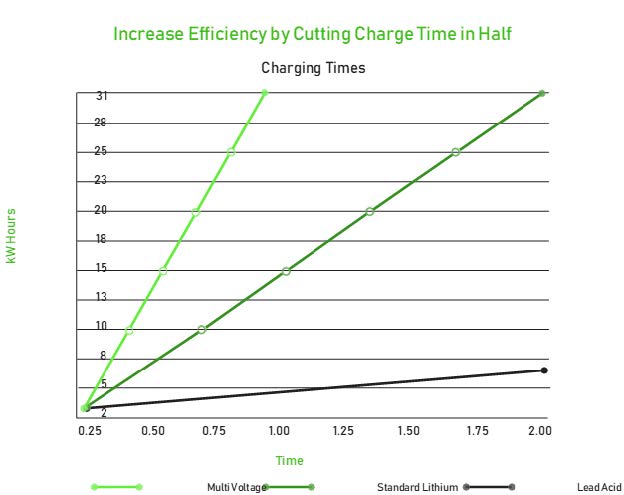
Also, most lithium-ion batteries can be recharged over 90% capacity in under two hours, while VRLA batteries may take anywhere from four to 24 hours to fully recharge. If an edge data center or 5G cell station has multiple utility outages in a single day, the lithium-ion batteries can quickly be recharged to provide ride-through time for each outage. Additionally, Lithium-Ion batteries can be paired with Solar, Wind, or fossil fuel generators to charge quickly and discharge slowly, optimizing energy harvesting when it is available.
Extended Lifespan & Cycle Life
Lithium-ion batteries have a lifespan of 10-15 years, which is 2-3 times as long as the average 5-7 year lifespan of lead acid batteries. A lithium-ion battery may easily last the entire 15-year lifespan of your UPS. Also, lithium-ion batteries have a predictable degradation curve, which makes it easier to determine when they are approaching “end of life” and will need to be replaced; unlike lead acid batteries, aging lithium-ion batteries are not subject to “sudden death syndrome.”
A typical lead acid battery has a cycle life of 200, meaning you can discharge the battery to 50% capacity and recharge it to 100% capacity, up to 200 times before the battery dies. But we know when you use a battery, you usually discharge it all the way to empty, damaging the lead acid battery. The lithium-ion chemistries used in batteries for UPS applications each have a longer cycle life – 1,000-2,000 cycles for the Nickel Manganese Cobalt (NMC) chemistry, and 2,000-4,000 cycles for the Lithium Iron Phosphate (LFP) chemistry. Figure 2 summarizes the uses and benefits of these two chemistries. Additionally, you can discharge lithium-ion batteries from 100% to 0%, which is twice the available capacity of lead acid batteries without doing any damage to the cells at all!

Smaller Size and Lower Weight
Lithium-ion batteries are up to 70% more compact than lead acid batteries. The smaller size of lithium-ion batteries makes it easier to install them in space-constrained deployments, such as modular or containerized data centers, 5G micro nodes, and data closets.
Also, lithium-ion batteries typically weigh about 1/3 less than most VRLA batteries. The lower weight makes lithium-ion batteries easier to carry, transport, and install, especially when delivering them to remote locations. Just talk to an installer, their knees and backs will thank you!
Temperature Tolerance
In outdoor settings, lithium-ion batteries can tolerate higher (and lower!) ambient temperatures, and are less susceptible to sudden temperature changes that would shorten a lead acid battery’s useful life. In indoor settings, lithium-ion batteries provide a savings in cooling costs, since server rooms and data closets can be kept at a higher ambient temperature without fear of damaging the batteries.
Less Maintenance
All lithium-ion batteries have a built-in Battery Management System (BMS) that monitors battery performance, reducing the risk of sudden battery failure. The BMS provides automatic status and fault monitoring, cell balancing, and power optimization for each individual battery.
A well-designed lithium-ion battery is virtually maintenance free, making it a “set it and forget it” solution. The BMS allows technicians to monitor battery health, in either a local or remote deployment. This allows you to maximize battery life, minimize downtime, and reduce labor and maintenance costs.
Cost Comparisons – Lithium-Ion vs. Lead Acid Batteries
Although the costs have decreased significantly over the last decade, lithium-ion batteries can require a higher initial investment than lead acid batteries. However, depending on the costs of the application, lithium-ion batteries offer long-term savings in Total Cost of Ownership (TCO) when used in 5G and IT network deployments. Figure 3 shows some of the categories to consider when selecting a backup power chemistry for your long-term deployment. Each deployment is different, but stationary battery applications typically operate for very long periods, many more than 15 years.

Figure 4 shows the cumulative cost differential over the 15-year lifespan that is typical of a UPS. While the initial costs of lead acid battery systems are lower, the total costs steadily increase over time, as the VRLA batteries must continuously be maintained and periodically replaced. Meanwhile, over this same period, the recurring costs of lithium-ion batteries are minimal, producing a Return On Investment (ROI) within five years of the initial battery deployment.

As mentioned, the longer lifespan and reliability of lithium-ion batteries means that they may last for the entire life of your UPS. This eliminates the cost of replacing batteries every few years, and also provides potential savings in labor, maintenance, shipping, and transportation that would otherwise be needed to service and replace the batteries in remote locations.
All in all, Lithium-ion batteries benefits for stationary applications are at a tipping point. Many network operators are considering lithium-ion batteries as a cost saving, higher performing alternative to the traditional Valve Regulated Lead Acid batteries they are used to using. Is it time to consider using Lithium-ion batteries to backup your mission critical loads?
Read the original article at Power System Design.