
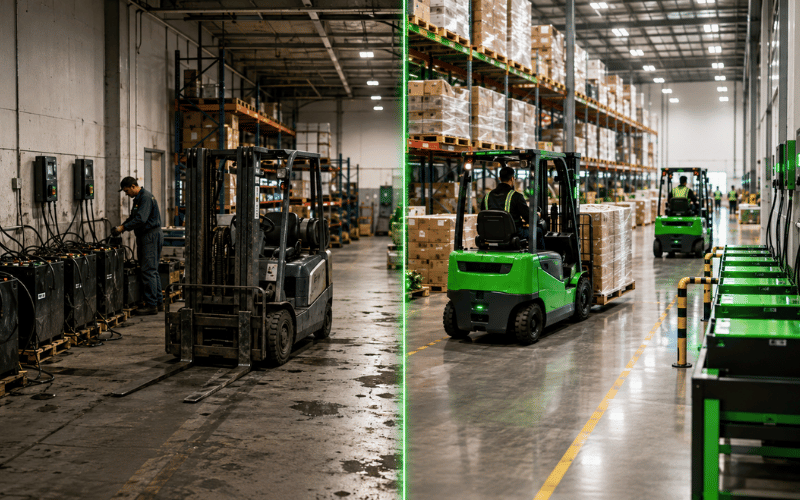
When teams compare lithium forklift batteries with lead-acid batteries, the conversation often starts with purchase price. That is understandable, but it is also incomplete. A forklift battery is not just a line item. It affects charging time, maintenance labor, equipment availability, battery room requirements, replacement cycles, and operator productivity.
The better comparison is total cost of ownership. TCO looks beyond the initial purchase and asks a more useful question: what does each battery option cost the operation over time?
This guide compares lithium forklift batteries vs lead-acid batteries across the categories that matter most, including maintenance, charging, downtime, service life, and common use cases. It also includes a simple decision matrix for single-shift, multi-shift, and high-utilization warehouse operations.
Why purchase price does not tell the full story
Lead-acid batteries usually have a lower upfront cost, which can make them look attractive in a basic bid comparison. But lead-acid programs often require more maintenance, longer charging windows, battery watering, battery rooms, swap equipment, spare batteries, and more labor to keep the fleet moving.
Lithium forklift batteries usually have a higher upfront cost, but the operating model is different. They can reduce maintenance requirements, support faster charging, and make opportunity charging more practical. For many facilities, the value comes from keeping equipment available and reducing the hidden costs that build up around battery management.
Green Cubes’ lithium forklift batteries page is a strong product-level resource for buyers comparing forklift battery options, especially when the goal is reliable material handling performance with less operational friction.
Maintenance cost: lead-acid needs more hands-on care
Maintenance is one of the clearest differences between lead-acid and lithium. Lead-acid batteries require routine attention, including watering, cleaning, equalization, and corrosion control. These tasks may look small on paper, but they become meaningful when multiplied across a fleet and repeated every week.
Lithium systems simplify the maintenance model. They do not require watering, and many battery health functions are managed through the battery management system. That does not mean teams can ignore inspections, but the labor burden is usually lower.
For operations where maintenance teams are already stretched, this shift matters. It reduces the number of routine tasks required to keep equipment available and lowers the risk of performance problems caused by missed maintenance.
Charging cost: time is the real expense
Charging is where TCO gets interesting. A lead-acid battery program may require long charging windows, cooling periods, and spare batteries to keep forklifts available across shifts. That creates space, labor, and equipment costs beyond the battery itself.
Lithium batteries can support faster charging and opportunity charging. Instead of removing a battery from service for a long charging cycle, operators can plug in during breaks or natural pauses. This can reduce the need for battery swaps and help keep trucks in service longer.
Green Cubes’ opportunity charging resource is a natural internal link here because charging behavior is one of the largest practical differences between lithium and lead-acid battery programs.
Downtime cost: small delays get expensive fast
Downtime is often the most underestimated part of battery TCO. A dead or underperforming forklift can slow receiving, replenishment, staging, and shipping. Operators may wait for equipment, supervisors may reshuffle work, and other trucks may be pulled away from priority tasks.
Lead-acid programs can create downtime when charging windows are too long, swaps are delayed, or battery maintenance is inconsistent. Lithium programs can reduce downtime by keeping trucks available through shorter charging events and more predictable power delivery.
The financial impact depends on your operation. A single-shift facility with low utilization may not feel downtime as severely. A high-volume distribution center running multiple shifts absolutely will. That is why the right answer depends on use case, not just chemistry.
Lifecycle and replacement cost
A battery with a lower purchase price can become more expensive if it needs to be replaced sooner or requires more support over its life. Lead-acid batteries can perform well when maintained correctly, but poor charging habits, missed watering, heat exposure, and heavy use can shorten service life.
Lithium forklift batteries are often selected for longer lifecycle expectations, lower maintenance burden, and more consistent performance over time. When evaluating lifecycle cost, teams should include replacement frequency, downtime during replacement, disposal or recycling handling, and the impact of declining performance near end of life.
Green Cubes’ lithium forklift battery ROI and payback guide is a helpful follow-up for teams that want to turn these cost categories into a practical payback estimate.
Facility space and battery room requirements
Lead-acid programs often require dedicated battery rooms or charging areas with space for charging, cooling, watering, and battery handling. Depending on the facility, that space could otherwise be used for staging, storage, or workflow improvements.
Lithium can simplify battery room requirements because it reduces the need for swaps, watering, and some traditional maintenance infrastructure. Facilities still need safe, well-planned charging zones, but the workflow can be cleaner and easier to manage.
Green Cubes’ motive batteries and chargers page is a good internal link for buyers evaluating batteries and chargers as a system rather than separate purchases.
Decision matrix: lithium vs lead-acid by use case
Use case | Lead-acid may fit when… | Lithium may fit better when… |
Light single-shift use | Trucks run limited hours, charging happens overnight, and maintenance is consistent. | The facility wants lower maintenance, faster charging, or fewer battery-related interruptions. |
Standard warehouse operations | Budget is tight and downtime risk is manageable. | Equipment availability, cleaner charging routines, and reduced maintenance labor matter. |
Multi-shift operations | The facility has spare batteries, battery rooms, and labor to manage swaps. | The fleet needs opportunity charging, reduced swaps, and higher uptime across shifts. |
High-throughput distribution | Lead-acid can work, but it often requires more infrastructure and discipline. | Downtime is expensive, charger strategy is critical, and productivity gains justify the investment. |
Cold storage or harsh environments | The battery program is already designed for the environment and carefully maintained. | The facility needs more predictable performance and a battery strategy matched to demanding conditions. |
The matrix is not about declaring one option universally better. It is about matching the battery program to the operational cost of downtime and maintenance.
Simple TCO categories to calculate
To compare lithium and lead-acid properly, gather the following numbers:
- Battery purchase price
- Charger cost and required infrastructure
- Maintenance labor hours per week
- Battery watering, cleaning, and handling tasks
- Downtime hours tied to charging or battery availability
- Spare battery requirements
- Battery replacement interval
- Space required for charging and battery handling
- Service and support expectations
Once those numbers are visible, the real cost picture becomes much clearer. A lower-cost battery may still be the right choice for light use. For heavier operations, lithium may win because it reduces the costs that do not show up on the first quote.
Common conclusion by operating profile
For light single-shift fleets, lead-acid can still make sense when budgets are tight and charging happens reliably overnight. The tradeoff is that the team must maintain the batteries correctly and accept longer charging routines.
For multi-shift fleets, lithium often becomes the stronger TCO option because opportunity charging, reduced maintenance, and fewer battery swaps directly support uptime. For high-utilization warehouses, the decision is even more operational. If downtime causes labor delays, missed throughput, or equipment shortages, lithium’s value can go beyond the battery itself.
Green Cubes also offers a detailed guide on how to choose the right forklift battery that can support buyers comparing forklift battery types, sizes, charging considerations, and operational fit.
TCO is a strategy conversation
The best forklift battery decision is not always the cheapest option. It is the option that supports the facility’s uptime, labor, safety, and productivity goals at the lowest total cost over time.
Lithium forklift batteries vs lead-acid is not just a chemistry comparison. It is a comparison between two operating models. One model depends on longer charge routines, more maintenance, and more battery handling. The other supports faster charging, lower routine maintenance, and a more flexible uptime strategy.
Next step
Green Cubes can help compare lithium forklift batteries vs lead-acid using your actual fleet size, shift schedule, charger layout, and downtime assumptions. That makes the TCO conversation specific to your operation instead of a generic battery comparison.
Request a quote to evaluate the right forklift battery solution for your fleet.
DISCLAIMER Please note that everything posted on this site is up to date at the time of posting. Things change and products may be discontinued at any time. Please contact us for the most up to date information.